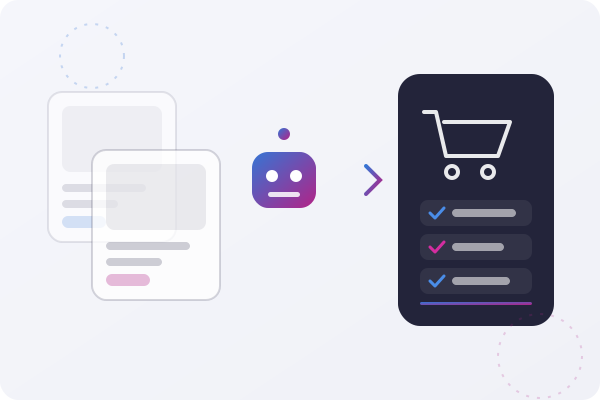
Somewhere right now, a shopper is telling an AI assistant to find them the best deal on a queen bedhead, order it, and have it delivered before the in-laws arrive. The assistant will compare a dozen stores, read the specs, check the shipping, assemble the cart, and complete the purchase. The shopper will never see your homepage, your hero banner, or your carefully chosen brand font. If your store speaks the agent’s language, you win the sale. If it doesn’t, you were never in the running.
We wrote earlier this year about AI agents working for small businesses: answering enquiries, chasing invoices, doing the admin. This article is about the other side of that coin. Agents are now doing the shopping, and that changes what a good online store looks like.
The Short Version
Between 2023 and 2025, AI mostly recommended products to humans who still clicked buy. In 2026, shopping agents built into ChatGPT, Google, and the major browsers can compare options across merchants, fill a cart, and check out on their owner’s behalf. Morgan Stanley projects that nearly half of online shoppers will use an AI shopping agent by 2030, accounting for roughly a quarter of their spending.
The good news: making your store agent-readable is not exotic work. It is clean product data, honest pricing, proper structured data, and fast pages. Every one of those also improves your conversion with humans, your Google Shopping visibility, and your presence in AI search answers. This is a no-regrets project, and the stores that do it early get quoted while their competitors get skipped.
How a Shopping Agent Actually Sees Your Store
A human shopper is persuaded by design: photography, layout, social proof, the feel of the brand. An agent is persuaded by data. When it lands on your product page it is looking for a machine-readable answer to five questions:
- What exactly is this product? Name, brand, model, variant, identifiers like SKU or GTIN.
- What does it cost, really? Price, sale price, currency, shipping cost, and any conditions.
- Can I get it? Live stock status, delivery timeframes, click and collect options.
- Can I trust it? Review counts and ratings, returns policy, warranty terms.
- Can I act on it? A checkout that standard automation can complete without fighting popups, forced account creation, or broken scripts.
If those answers live only in a hero image, a PDF, or text rendered by a fragile JavaScript widget, the agent either guesses or moves on. Agents do not browse with patience. They rank the stores that answer cleanly and skip the ones that make them work.
The Agent-Readiness Checklist
Here is the practical list we work through when we prepare a store for agentic commerce. It applies equally to Shopify and WooCommerce.
1. Product structured data, complete and accurate
Schema.org Product markup is the backbone: name, description, image, brand, SKU, GTIN where you have it, plus an Offer with price, currency, and availability. Ratings and review counts belong in there too. Most themes emit partial markup at best. An audit usually finds missing prices on variants, no availability field, or review stars that exist on the page but not in the data.
2. Titles and specs written for comparison
“The Byron” means nothing to an agent comparing bedheads. “Byron Queen Bedhead, Natural Linen, 165cm wide” wins the comparison. Put real specifications in text: dimensions, materials, capacity, compatibility. If your spec sheet is a JPEG, it is invisible.
3. Live stock and honest pricing
Agents remember. If your data says in stock and the checkout says otherwise, or a “sale” price never changes, you burn trust with the systems deciding who gets recommended. Keep availability live, keep pricing truthful, and show shipping costs before checkout. Agents compare total landed cost, not sticker price.
4. Fast, crawlable pages
Agents operate on budgets: time budgets and crawl budgets. Server-rendered or static pages that deliver content as HTML get read fully. Stores that need eight seconds of JavaScript before the price appears get sampled or skipped. This is the same performance work Google has rewarded for years, now with a second audience. Our hosting and performance service exists for exactly this.
5. Policies an agent can quote
Returns, warranty, shipping timeframes, and support contact should exist as plain text on stable URLs, ideally with matching schema. When an agent justifies its pick to its owner, “free 30-day returns” is a selling point it can only use if it can find it.
6. A checkout that automation can finish
Guest checkout, standard address fields, mainstream payment options. Every dark pattern that annoys humans, forced account creation, surprise fees on the last step, newsletter popups that trap focus, is a hard failure for an agent. The emerging agent payment protocols will formalise this, but a clean conventional checkout is what works today.
7. Clean product feeds
A well-maintained Google Merchant Centre feed already gives agents a structured catalogue to read, and the same discipline powers Meta catalogues and marketplace listings. If your catalogue data is messy, this is where bulk product data cleanup pays for itself twice: once with the robots, once with the humans.
Want to Know if Agents Can Read Your Store?
We’ll audit your product data, schema, speed, and checkout, and give you a prioritised agent-readiness list.
Book a Free Store Audit →What Not to Panic About
Agent-driven purchases are still a small slice of Australian e-commerce today. Humans remain the overwhelming majority of your traffic, and nothing above asks you to compromise the human experience. That is the point: the store that is easy for an agent to buy from is also easier for a person to buy from. Faster pages convert better. Clearer specs reduce returns. Honest shipping costs reduce cart abandonment. You are not rebuilding for robots, you are removing the friction both audiences hate.
Be equally calm about the vendors selling “agentic commerce platforms” with urgent countdowns. You do not need a new platform. You need your existing store to publish clean data and load quickly.
Where Shopify and WooCommerce Each Stand
Shopify ships with reasonable Product schema and a checkout agents handle well, and its platform team is building for agentic commerce directly. Audit rather than assume: apps and theme customisations frequently break or duplicate the markup, and variant-level pricing is a common gap.
WooCommerce gives you full control, which cuts both ways. Out of the box the structured data is basic, and page speed depends entirely on your theme, plugins, and hosting. The upside: with disciplined setup, a WooCommerce store can publish richer, more precise data than any closed platform. That discipline is the job.
Either way, the sequence is the same: fix the data, fix the speed, verify the markup with Google’s Rich Results Test, then keep it accurate. It pairs naturally with the AI-era SEO work of being cited by answer engines: the store that AI search quotes and the store that AI shoppers buy from are built with the same materials.
A 30-Day Game Plan
- Week 1: Run your top ten product pages through Google’s Rich Results Test. List every missing or wrong field.
- Week 2: Fix the schema and rewrite your top product titles and specs for comparison. Real dimensions, real materials, no mystery names.
- Week 3: Measure page speed on 4G. If products take more than three seconds to show a price, book the performance work.
- Week 4: Walk your own checkout as a stranger: guest checkout on, popups off, shipping costs visible early. Then set a monthly data-accuracy check so stock and pricing stay truthful.
The Final Word
Every few years e-commerce quietly changes its front door. It was Google Shopping, then mobile, then marketplaces. The next front door is an AI agent with a shopping list, and it is already standing on the mat. The stores it recommends will be the ones that answered its five questions clearly: what is it, what does it cost, can I get it, can I trust it, can I buy it.
Your website already answers those questions for people. Now make it answer them for the robot doing the people’s shopping.
Ready to Make Your Store Agent-Proof?
We build and tune Shopify and WooCommerce stores for the way people, and their AI assistants, actually buy in 2026.
Explore Our E-Commerce Services →