For years, “AI for small business” meant one thing: a chatbot in the corner of your website answering questions about opening hours. Useful, occasionally. Transformative, no.
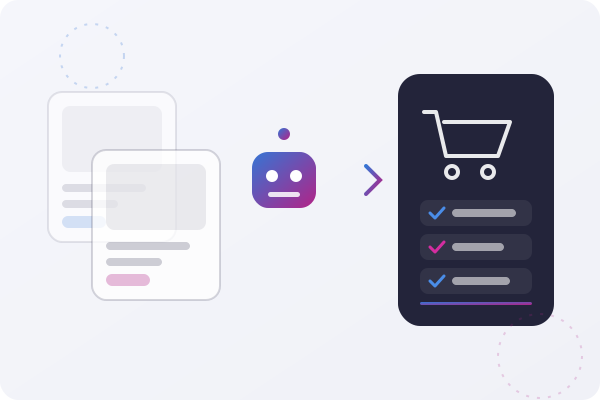
That era is over. The big shift in AI this year isn’t a smarter chatbot, it’s the move from answering questions to finishing jobs. The industry calls these systems AI agents, and the difference matters: a chatbot tells your customer what your refund policy is; an agent looks up the order, checks it against the policy, processes the refund, emails the confirmation, and logs it in your accounting software.
Recent surveys suggest nearly four in five small business owners now say AI is more useful to them than it was a year ago. But there’s still a wide gap between businesses that use AI and businesses that benefit from it, and that gap is mostly about understanding what agents can genuinely own. So let’s get specific.
Chatbot vs Agent: The Difference in One Minute
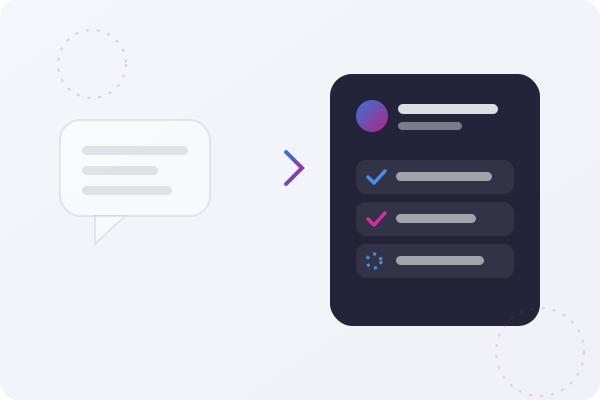
A chatbot is a conversation. An agent is a worker with tools.
- A chatbot reads your question and writes an answer. Its world ends at the chat window.
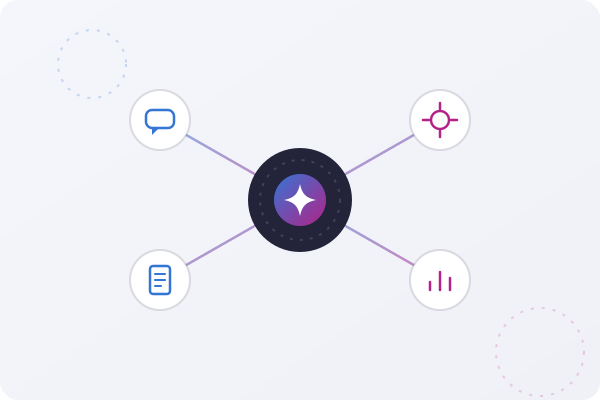
- An agent has goals, memory, and access to your actual systems, your inbox, calendar, CRM, store, invoicing software. It can take an instruction like “follow up every quote older than seven days” and carry it out, step by step, checking its own work along the way.
The practical test: can it finish a job while you’re not watching? If yes, it’s an agent. If it just talks about the job, it’s a chatbot.
If you’re still at the “where would AI even fit in my business?” stage, our earlier guide How Do I Use AI in My Business? is the right place to start. This article is the next level up.
Six Jobs an AI Agent Can Actually Own in 2026
1. Lead qualification and follow-up
An enquiry lands at 9:40pm on a Saturday. An agent reads it, checks whether it matches the work you actually do, asks the two or three qualifying questions you’d ask yourself (budget, timeline, location), books qualified leads straight into your calendar, and politely redirects the rest. By Monday morning you have meetings, not a backlog.
This is consistently where small businesses see the fastest payback, because speed-to-response is the single biggest factor in winning enquiries, and an agent’s response time is measured in seconds, around the clock.
2. Customer service that goes past the FAQ
Connected to your store or booking system, an agent can look up a customer’s actual order, give a real delivery estimate, change a booking, or start a return, the things customers actually email you about. The well-designed version knows its limits: anything unusual or emotionally charged gets handed to a human, with a tidy summary attached.
3. Quotes and proposals
Trades and service businesses lose hours every week assembling quotes that are 80% identical. An agent can take the job details from an enquiry, pull your current pricing, draft the quote in your format and your tone, and queue it for your sign-off. You stay the decision-maker; you stop being the typist.
4. The paperwork nobody loves
Invoice chasing, receipt categorisation, reconciliation against your accounting software, contract review for the usual red flags: this is exactly the “narrow, supervised” work where agents shine. It’s repetitive, rule-based, and high-volume, which is precisely the profile of work you should not be paying humans to do in 2026. We covered the cost side of this in How Australian SMBs Can Adapt to Rising Operating Costs with Automation.
5. Marketing operations
Not “AI writes your brand voice”, that still needs you. But the operational layer around it: drafting posts from your photos and job notes, keeping your Google Business Profile fresh, monitoring which pages are winning in search and flagging the ones slipping. An agent turns marketing from a thing you forget into a thing that nudges you.
6. Watching your website so you don't have to
This one we run ourselves: agents that monitor uptime, performance, and broken links, apply security updates, and flag anything odd before customers notice. It’s the difference between finding out your contact form broke today and finding out it broke three weeks and forty lost enquiries ago. It’s also the backbone of our Managed Hosting & Performance service.
Want to know which of these would pay off first in your business?
We build custom AI agents for Australian small businesses, starting with the one task that saves you the most hours.
Explore AI Agents & Automation →What Agents Still Can't Do (and Shouldn't)
The businesses getting burned by AI this year are the ones treating agents as unsupervised employees rather than fast, tireless juniors. A few honest rules:
- Agents need guardrails. Give an agent a narrow job, clear boundaries, and an approval step for anything customer-facing or money-moving. The wins come from supervised, well-scoped work, not from “run my business for me.”
- They don’t own relationships. An agent can draft the apology email; whether to comp the customer’s next order is your call.
- They’re only as good as your systems. If your pricing lives in your head and your bookings live in a paper diary, the first project isn’t an agent, it’s getting your information somewhere an agent can reach.
What This Costs (the Honest Version)
The economics have changed dramatically. Two years ago, custom AI automation was enterprise territory. In 2026, a single well-built agent handling one job, lead follow-up, say, is a modest one-off build plus a small monthly running cost, and it typically replaces hours of admin every week from day one. The mistake to avoid is the opposite one: subscribing to six overlapping AI tools that each do 10% of a job and integrate with nothing.
Start with one job, measure the hours it gives back, then add the next.
A 30-Day Starting Plan
- Week 1: Track where your admin hours actually go. The winner is usually obvious, and it’s usually enquiries or paperwork.
- Week 2: Write down how you do that task today, step by step, including the judgment calls. This becomes the agent’s job description.
- Week 3: Build (or have built) an agent for that one task, running in draft mode, it prepares everything, you approve everything.
- Week 4: Review its work. Promote what it gets right to fully automatic; keep approval steps on the rest.
That’s it. No transformation roadmap, no enterprise platform, one job, done properly, then the next one.
The Bottom Line
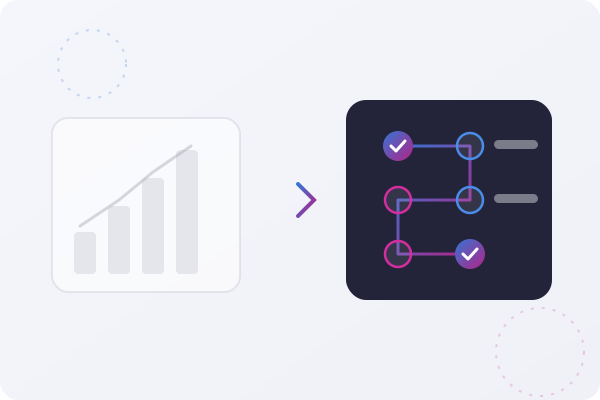
The chatbot era asked, “can AI talk to my customers?” The agent era asks a better question: “which jobs in my business can run themselves?” In 2026 the realistic answer for most small businesses is: more than you’d think, enquiries, follow-ups, quotes, paperwork, marketing ops, and the website itself, provided each agent is given one clear job and a human to answer to.
Your competitors with ten times your headcount are already doing this. The good news: agents are the great equaliser, and they don’t care how big the team is.
Ready to hire your first AI employee?
Tell us about the task that eats your week. We’ll tell you honestly whether an agent can own it, and what it would take.
Get in Touch →